Table of contents
There is a moment in the maturation of every great city when its architecture stops trying to prove a point and starts, instead, to refine one. Dubai is approaching that moment. The decade of record-breaking towers and engineering bravado has produced a skyline of global recognition. What it has not yet produced, with any consistency, is a residential architecture that speaks the same language of permanence as the world’s other prime cities. The arrival of Killa Design as the lead architect on Amali Residences is, by some distance, the most serious response to that question the city has yet seen.
From Public Landmark to Private Address
Shaun Killa founded Killa Design in Dubai in 2015 after a long tenure leading the design studio at Atkins, where he was the creative force behind some of the city’s most photographed structures. His most internationally recognised work remains the Museum of the Future, the calligraphy-clad torus on Sheikh Zayed Road that opened in 2022 and has, in the years since, become a kind of unofficial emblem of contemporary Dubai. It has been featured in National Geographic, the Financial Times, and Architectural Digest. It is, on most measures, the most architecturally serious building Dubai has produced in the post-Burj Khalifa decade.
Killa Design’s pivot toward ultra-residential work is, therefore, not a routine commission. It is a deliberate move by a studio that, until now, has been primarily associated with civic, cultural, and commercial landmarks. Its portfolio includes the Office of the Future, the world’s first fully 3D-printed office building; the SHANTI Maurice hotel in Mauritius; and a series of master-planning works across the Gulf. The studio has consistently been recognised by the Council on Tall Buildings and Urban Habitat and has been featured in the studio profiles of Dezeen and ArchDaily.
The decision to sign Amali, the first private ultra-luxury residential project the studio has approached at this scale, signals something about the project’s ambitions and something about Dubai’s architectural trajectory more broadly.
The Cultural Argument for a Studio Like Killa
For most of its modern history, Dubai’s residential architecture has been delivered by a relatively small group of large engineering-led practices working at speed and at scale. The model produced a great deal of competent product, but it rarely produced what international observers would describe as architecturally signed work. The few exceptions, the Foster and Partners towers in Business Bay, the Heatherwick-designed Bvlgari villas on Jumeira Bay, the Zaha Hadid Architects’ Opus, are instructive precisely because they are exceptions.
This is the pattern the global luxury market increasingly expects to see broken. In London, the most consequential residential launches of the last decade have all carried architectural signatures: David Chipperfield at One Kensington Gardens, Foster and Partners at Chelsea Barracks, Renzo Piano on the South Bank. In New York, the residential canon has been rewritten by Robert A.M. Stern, Jean Nouvel, and Annabelle Selldorf. The point is not that the buildings are beautiful, though many are. The point is that the architect is a guarantor of long-term value. A Stern building in Manhattan trades at a measurable premium over an unsigned neighbour. A Chipperfield building in Mayfair does the same.
Dubai is now reaching the moment at which that calculus begins to apply. Knight Frank’s most recent commentary on the Dubai luxury market has noted that branded and architecturally led inventory commands a measurable premium over the broader prime index, with the gap widening rather than narrowing. JLL has flagged a similar pattern in its quarterly Dubai notes.
The twin-tower at Al Wasl is the most explicit attempt yet to deliver, on the Canal, a residential proposition that meets that international standard.
Reading the Facade
The architectural signature of Amali is, at first reading, restrained. There is no torus, no cantilever, no engineering stunt. Instead, the twin-tower composition relies on a more European vocabulary of proportion, repetition, and material weight. The two towers rise as paired volumes above a generous podium, with a framed dialogue between them that creates a third, implied volume of canal-facing air.
The decision to design as a pair rather than as a single landmark is significant. A pair imposes discipline. The two towers must read as siblings rather than as a tower with a satellite. They must share a vocabulary while accommodating different residence types and different orientations to the canal and to the city. The architectural challenge is, in many ways, harder than designing a single icon.
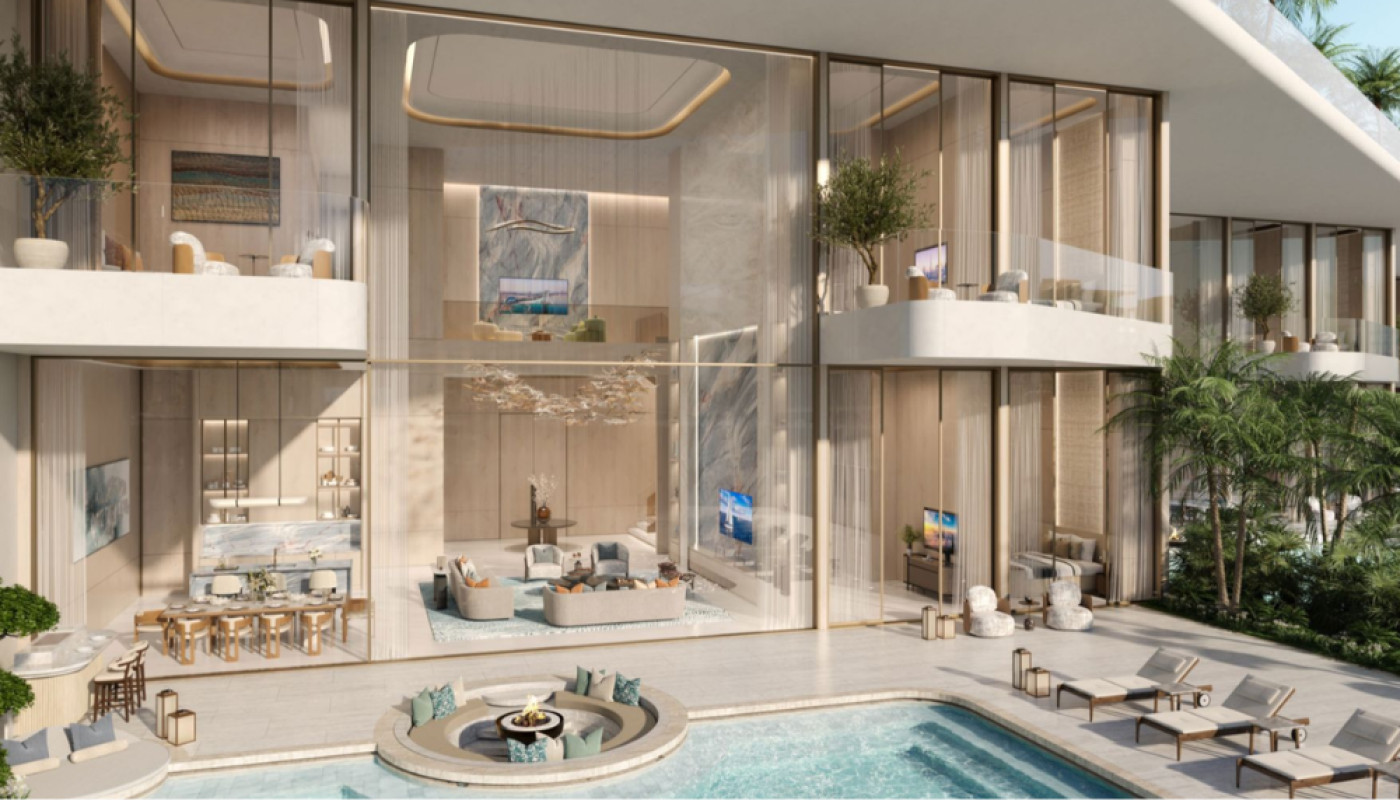
The facade itself is structured around the kind of deep, sculpted balconies and floor-to-floor glazing that the project’s 5.5 metre floor-to-floor heights make possible. That dimension is, in Dubai residential terms, almost unheard of. Most prime towers in the city deliver between 3.2 and 3.8 metres floor-to-floor. The Amali specification adds, on average, two additional metres of vertical generosity to every residence.
The architectural consequence of that decision is substantial. It allows full-height glazing without the visual compression that lower ceiling heights produce. It allows the interior planning to accommodate the kind of layered, gallery-style circulation that European prime residences have historically delivered. It allows terraces deep enough to function as outdoor rooms rather than as decorative ledges. And it allows the building, when read from the canal, to express its residential generosity in its proportions rather than only in its plan.
Indoor-Outdoor in a Vertical Building
The architectural problem of indoor-outdoor flow has historically been a horizontal problem. Villas resolve it easily. Apartments rarely resolve it well. The Dubai climate, with its summer extremes and short cooler season, has made the problem harder, not easier. Most Dubai apartment terraces, even at the ultra-luxury end, function as semi-decorative outdoor extensions of an interior space rather than as genuine rooms.
Killa Design’s response at Amali is to push the terrace into the architectural plan as a primary, not a secondary, element. The depth of the balconies, the relationship between glazed and shaded surfaces, the orientation of each residence to its canal-facing or city-facing exposure, are all calibrated to create a usable outdoor space across a much longer portion of the calendar year. The private pool at every residence reinforces that intent. A pool on a balcony is a different specification from a pool in a clubhouse. It changes the script of how the residence is lived.
That choice, combined with the 5.5 metre floor-to-floor, produces a typology that is closer in spirit to a stacked villa than to a conventional apartment. It is the kind of architectural ambition that Killa Design’s studio is uniquely positioned to deliver, and it is the reason the project has attracted the level of international attention it has.
Material Language
Beyond the geometry, the project’s architectural seriousness is expressed in its material specification. The lobbies, lift cores, and common areas are clad in a palette that draws from Italian and Turkish stone traditions. Mother-of-Pearl marble. Rosso Orobico. Cipollino Verde. Blue Mountain marble. These are not the standard finish library of a Dubai luxury tower. They are the material vocabulary of a Milanese hotel, a Roman palazzo, a Parisian hotel particulier.
That choice is consequential. Material is, in luxury architecture, the longest-running argument. A facade reads at distance. A material reads at hand. The decision to invest at the level the Amali specification requires is a decision to make the building intelligible at both scales.
The kitchen specification follows the same logic. Gaggenau, the German appliance maker that has become, over the last decade, the default specification of the world’s most serious residential projects. Joseph Giles, the London ironmongery house whose hardware appears in the residences at Claridge’s and at One Hyde Park. The interior architecture by HBA Residential, the residential arm of Hirsch Bedner Associates, places the project firmly within the global ultra-luxury hospitality tradition.
Comparable Architect-Developer Collaborations
To understand the cultural weight of the Killa Design and Amali collaboration, it is useful to look at comparable architect-developer relationships in other prime markets. The Foster and Partners partnership with Qatari Diar and CPC at Chelsea Barracks in London is one. The Heatherwick Studio collaboration with Meraas on the Bvlgari villas on Jumeira Bay is another. Jean Nouvel’s relationship with Aby Rosen and Michael Stern on 53 West 53rd in Manhattan is a third.
In each case, the commercial logic of the partnership was the same. The architect provided a guarantor of design seriousness that the developer could not, on its own, deliver. The developer provided the scale and the operational sophistication that the architect could not, on its own, execute. The buyer received a product whose architectural provenance was, in itself, an asset.
The official Amali Residences brochure reads in the same register. The architect-developer pairing is presented as a primary attribute of the project, not as a marketing afterthought. Killa Design is named on the building. That is, in Dubai, still a rare thing.
What the Project Means for Dubai’s Architectural Maturity
The arrival of Amali should be read as part of a broader, slower shift in the Dubai market. The first phase of the city’s modern history was about scale. The second phase, the post-Expo, post-pandemic phase that began around 2022, has increasingly been about quality. Buyers entering the city at the ultra-prime end are no longer satisfied with size and view. They are asking, increasingly, the same questions that buyers in London, New York, and Hong Kong have asked for a generation. Who is the architect. Who is the interior designer. What is the material specification. What is the long-term liquidity profile of the address.
The Killa Design signature on Amali is, in that sense, more than a marketing line. It is a structural change in how Dubai’s prime market presents itself to the world. Arabian Business, in its recent coverage of the launch, framed the project as “a benchmark for what architectural seriousness looks like in 2026 Dubai.” Khaleej Times described the collaboration as “the most consequential architect-developer pairing the city has produced in the residential space.”
Those framings are not journalistic excess. They reflect a genuine shift. The city has, for the better part of a decade, been searching for a residential architecture that could carry its luxury market into a more durable, more internationally legible phase. With Amali, it has, arguably for the first time, found one.
A Studio in Its Second Act
For Killa Design, the project marks a second act. The Museum of the Future will likely remain the studio’s most internationally recognised work. But Amali establishes the studio in a different register. It positions Killa Design as a credible authority on residential design at the very top of the market, in a city that has, until now, not had a clear answer to the question of who its leading residential architect is.
It is too early to know whether the Amali project will, in the long run, be judged as the studio’s most important work. The completed building will, by Q4 2029, render its own verdict. But the architectural moment, the moment at which Dubai signed an architect of Killa’s stature for an ultra-prime residential commission on its most coveted waterfront, has already happened. That moment, more than any single design detail, is the milestone.
On the same subject

How To Simplify Legal Navigation For Expats In A New Country?

Discover Exceptional Properties for Sale in Sint Maarten with 4U Real Estate

The Silent Wealth Killer: Understanding Inflation and Your Savings

Fintech Revolution: How Technology is Shaping Personal Finance

Navigating the Investment Jungle: Understanding ETFs and Mutual Funds

Breaking the Glass Ceiling: Women Leading in Wall Street
